You are the escalation path for everything — and that's the bug
Count the interruptions in your last week. Vendor asking about a payment. Team member asking which order ships first. Customer asking for a status. An "urgent" email that wasn't. Each one individually justified; together they mean your business cannot make a routine decision without you.
Every growth book tells you to delegate. Nobody tells you why delegation keeps failing: your people can't decide because the rules for deciding live in your head, and your head is in every meeting.
The core principle: variance has two kinds
Routine variance — a delivery slips a day, an invoice is paid late, an order arrives in two batches instead of one. Annoying, expected, handleable by rule. If your business has a rule for it, it should never reach you.
Judgment variance — your biggest client hints at leaving, a key vendor's quality drops two batches in a row, a competitor's pricing move changes your margins. No rule covers these. They need your experience. These are the only things that should interrupt you.
A system that escalates everything escalates nothing. The value of an alert is the noise it refuses to make.
The architecture: four layers
Layer 1 — One source of truth (week 1-2)
Every order, commitment, and follow-up in one place — however ugly. One order sheet beats four "systems." If information lives in two places, one of them is already wrong.
Layer 2 — Rules absorb routine variance (week 2-3)
Write the rules down. Delivery slips <3 days → inform customer automatically, adjust dispatch date. Invoice >7 days late → reminder at day 7, 14, 21 → escalate at 30. RFQ unanswered in 48h → re-send with different subject. Each rule is trivial. The stack of them removes 80% of your interruptions.
Layer 3 — The system chases, humans judge (week 3-4)
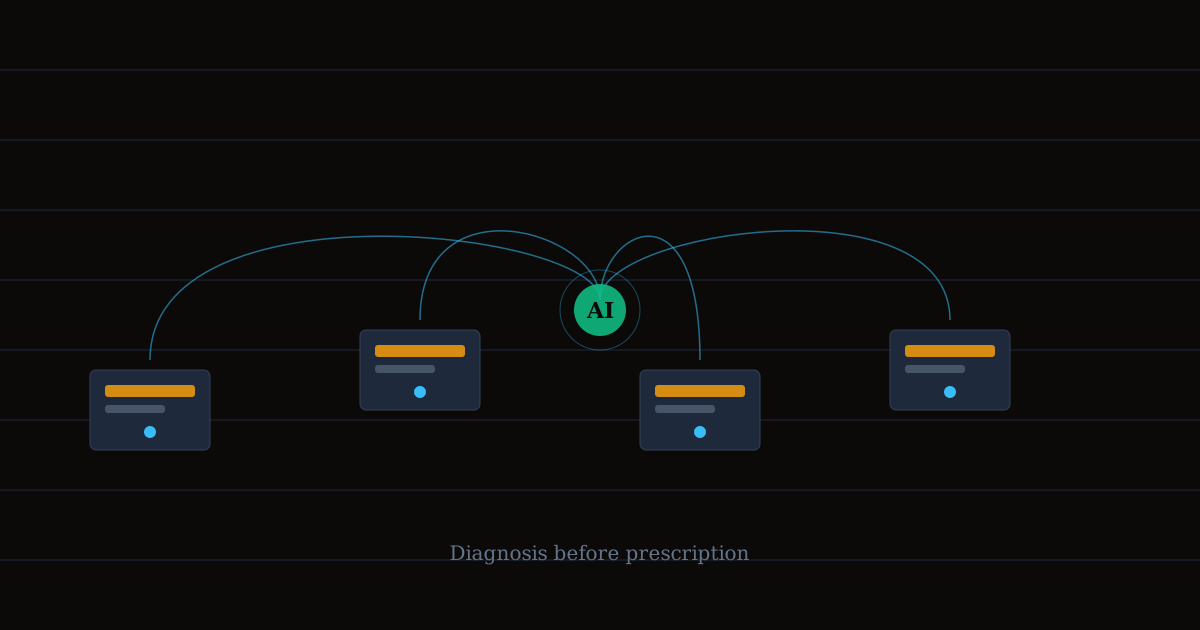
Automate the rules: reminders, follow-ups, status updates, acknowledgment emails. Not "AI" — reliable plumbing. Where AI genuinely helps: drafting the context-heavy follow-up and triaging which exceptions look like judgment calls. The system does the chasing; you do the deciding.
Layer 4 — The daily one-page brief
Every morning, one page: what slipped since yesterday, what's at risk in the next 7 days, what needs your decision — and nothing else. This page is the entire reporting layer. If it can't fit on one page, your rules need work, not your briefing.
What changes in month one
- Interruptions drop by half or more — the routine 80% is being absorbed by rules you wrote once.
- Nothing falls through — follow-ups don't depend on anyone remembering.
- Your judgment gets scarcer and more valuable — you're now spending it only where it moves the business.
- Delegation finally works — the rules are written down; your team executes them without asking you.
The honest failure modes
- Rules that nobody maintains. A stale rule escalates the wrong things. Review monthly, kill rules that fire uselessly.
- The brief nobody reads. If your one-pager grows to three, you'll stop opening it. Ruthlessness about brevity is the whole game.
- Escaping into building instead of deciding. The system serves your judgment, not the reverse. If you're tweaking rules every day, you've built a new job, not removed an old one.
Start tomorrow morning
Take one recurring interruption — the one that hit you most this week. Write the rule that would have absorbed it. That's layer two, started. Thirty days of that, one rule at a time, and your business runs on a system instead of your memory. The AI wave will still be there when you're ready for it — and because of the plumbing you built, it will actually work.
Want the architecture mapped for your business?
Our Strategy Review diagnoses where your routine variance hides and hands you the rule list — whether or not you ever work with us.
Book a Strategy Review →